

Your circadian rhythm plays a key role in your sleep and energy levels. Many people also call it your “biological clock.” In this article, we’ll explain how to optimize your circadian rhythm for better sleep, so you’ll sleep better and feel more energized!
Every living being has a 24-hour clock that determines the natural rhythm in which your body and its organs function. This is called the circadian rhythm.
Besides your sleep-wake cycle, the circadian rhythm also dictates your preference for when you feel hungry, when you produce urine, and when your body produces hormones!
This rhythm causes elevated cortisol and adrenaline levels in the morning and throughout the day (which keeps you awake) and higher melatonin levels in the late evening and at night. Melatonin is the most important hormone for sleep.
This rhythm naturally repeats itself every 24 hours. The circadian rhythm has a huge influence on your behavior. In the modern world, however, we see this pattern or rhythm being disrupted in many ways: people don’t always eat breakfast properly, don’t build up enough sleep pressure, stay up late in front of the television or computer, or eat and drink at irregular times.
A good sleeper will find the right balance here by investing in a healthy circadian rhythm.
Key hormones that support your sleep are serotonin and melatonin. Serotonin plays a major role during the day; when sunlight shines on your retina (the part of your eye that captures light), your body receives a signal that it’s time to produce serotonin. Breakfast or physical activity can also trigger your body to produce serotonin.
The hormone serotonin plays a crucial role in various processes such as your mood, appetite, and digestive system. Serotonin plays a significant role in melatonin production; it’s been shown that your body needs serotonin to produce melatonin at the end of the day, when it gets dark in the evening.
Melatonin is the hormone responsible for your sleep. This makes serotonin (the daylight hormone) also essential for a good night’s sleep!
Many people today experience disruptions to their circadian rhythm. The light from our electronic devices has a huge impact on our sleep patterns. This light is also known as blue light. In Matthew Walker’s book “Why We Sleep: Unlocking the Power of Sleep and Dreams,” he emphasizes the negative effects of blue light on our circadian rhythm.
Walker describes a controlled laboratory experiment in which a group of healthy adults spent two weeks in the lab. The two-week period was halved with two different experiments:
The order of 1 or 2 was randomized across participants. Compared to reading a printed book, reading with an iPad resulted in a 50% decrease in melatonin. This means melatonin rise was delayed by 3 hours, into the early hours of the morning, while melatonin rise occurred more naturally when reading a printed book.
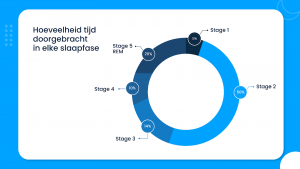
Did this also affect sleep quality? Absolutely. Some participants not only fell asleep later, but also lost a significant amount of sleep time. With the loss of sleep time, these individuals also entered the REM sleep phase less frequently during their sleep. This is the phase in which we experience dreams. One sleep cycle lasts about 1.5 hours. A good night’s sleep consists of 5 cycles of 1.5 hours, which amounts to 7.5 hours.
By reducing the duration of sleep, one also reduces the number of times one enters the REM phase, which is so healthy for humans.
This sleep phase plays a significant role in processing stress and emotions accumulated during the day.
Want to restore your circadian rhythms? These tips will help you get to bed at consistent times every day. Try to be mindful of your behavior before you go to bed and when you wake up.
The first tip for restoring your rhythm is to get sunlight as early as possible in the day and darken your rooms in time; light and darkness have the most significant impact on the production of the hormones serotonin and melatonin.
Try to keep the times you get out of bed in the morning and go to bed in the evening as rhythmic as possible! This makes it easier for your body to recognize when it can produce the hormones that influence your sleep. Will you give your body a helping hand? Try to respect the light and dark cycle. Rhythm is one of the most significant factors that good sleepers understand!
Besides serotonin and melatonin, there’s another hormone that can help you fall asleep: adenosine. When your day starts and you start exercising, your body starts burning energy; this releases adenosine, the levels of which build up throughout the day. This creates sleep pressure. When you exercise a lot, you create a lot of sleep pressure towards the end of the day. Burning energy can therefore significantly help you fall asleep.

While you sleep, the accumulated adenosine is broken down. When it reaches a low level, you wake up to start the day.
Caffeine is structurally similar to adenosine and therefore takes the place of adenosine in binding to the adenosine receptor. As a result, you temporarily experience no sleep pressure from adenosine. However, caffeine can disrupt adenosine regulation and affect your sleep.
Read more about sleep pressure, adenosine and caffeine in this blog.
Realize that nutrition plays a major role in hormone production. You influence serotonin production through diet, and therefore also melatonin, your sleep hormone.
Our diet can have a significant impact on our mood. It can either stimulate or discourage the production of certain hormones. Be aware of how interconnected the processes in our bodies are and that not all food is simply “energy.”
Each food has its own effect on our body and can have a positive influence on our sleep at one moment and a negative influence at another.
Take a look at our Consiouz food guide!
Discount Applied Successfully!
Your savings have been added to the cart.
